Biohybrid Robots in 2026: Living Skin, Artificial Muscles and What Comes Next
Researchers have built robotic faces covered in living skin, a mechanical hand driven by human muscle tissue and a tiny four-legged machine that moves when exposed to light. Here is what those experiments actually tell us about the future of robotics.
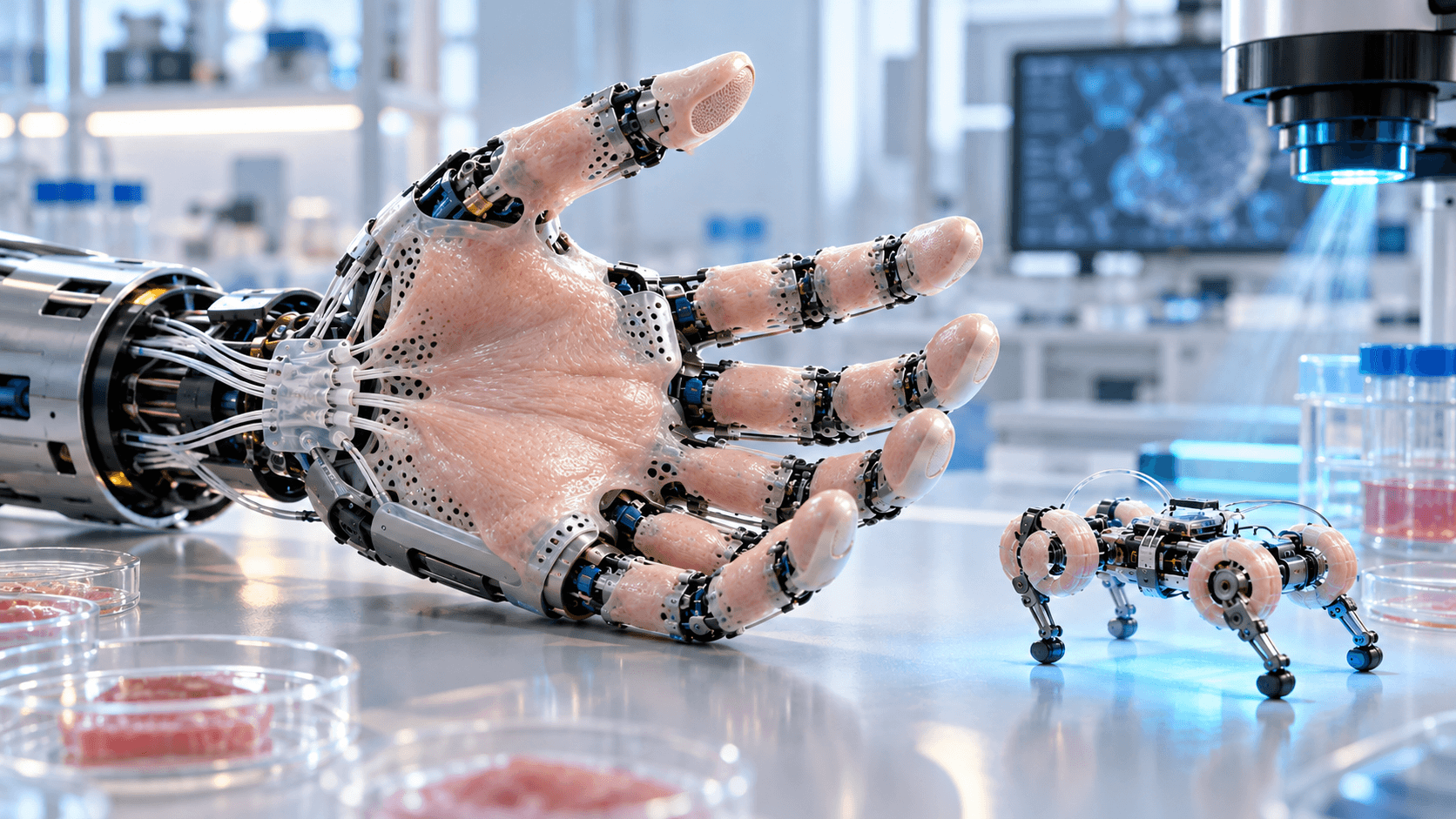
A robotic hand that bends its fingers using human muscle sounds like a scene from science fiction. Yet in February 2025, researchers published precisely that kind of experiment. The hand was 18 centimetres long. Its fingers moved because engineered muscle tissues contracted, pulling on cable-like tendons rather than relying on motors. 3
The experiment belongs to a growing field called biohybrid robotics, where living cells and artificial structures work together. In 2024, another research team demonstrated a robot face covered in cultivated human skin. In 2026, researchers reported a miniature four-legged device whose muscle-driven movements could be triggered with light. 2 4
None of these devices is a practical humanoid robot. All are important pieces of a different engineering story: instead of making machines imitate biology from the outside, scientists are starting to incorporate biological tissue into the machines themselves.
Key findings
- Living skin can be attached to moving robot surfaces. In 2024, researchers developed small perforated anchors that help cultivated skin adhere to a robotic face. The prototype could form a smile, but it did not demonstrate human-like sensation. 2
- Living human muscle can move a larger robotic hand. A 2025 study used five muscle-tissue actuators to operate an 18-centimetre, multi-jointed hand under laboratory conditions. 3
- Light can control a biohybrid walking gait. A 2026 paper described a miniature quadruped using optogenetically responsive muscle rings to lift and place its legs. 4
- Survival and control remain major constraints. Cultivated tissues need a suitable environment; fatigue, nutrient delivery and consistent performance are active research problems. 3 5
What exactly is a biohybrid robot?
A conventional robot relies on manufactured parts to sense and act: motors supply force, mechanisms transfer movement, and electronic sensors collect information. A biohybrid robot combines those engineered systems with living biological material. Cultivated muscle might supply motion. Engineered skin might cover a moving surface. Other designs investigate the interface between living tissue and electrical or optical controls. 5
The distinction matters because a robot covered in soft silicone is not automatically biohybrid. Nor is an AI-powered robot necessarily biohybrid. The defining feature is that some functional part of the system is living.
This is still a laboratory-focused field. Scientists are testing individual components and ways of integrating them, rather than assembling fully autonomous biological machines.
2024: How scientists gave a robotic face living skin
Human skin has a remarkable relationship with the tissue beneath it. It stretches as we move, but it also remains anchored in place. That combination is difficult to recreate on a robotic structure.
In a 2024 paper in Cell Reports Physical Science, Michio Kawai and colleagues described an attachment method inspired by the structures that connect human skin to underlying tissue. The researchers formed small perforations in an artificial substrate and used them to anchor a skin equivalent made from living cells and supporting matrix. They then demonstrated a facial structure with living skin that could form a smiling expression. 2
The achievement was not that the face looked convincingly human. It was the interface: researchers found a way to attach delicate living material to a shaped, moving surface without relying on conspicuous hooks.
Is that skin self-healing?
There is an important distinction here. In earlier work published in Matter in 2022, researchers covered a robotic finger with engineered living skin and demonstrated a wound-repair procedure in controlled culture conditions. 1
That is evidence that living skin on a robot can participate in a biological repair process. It is not evidence that the smiling face from 2024 could independently heal itself in everyday conditions. Neither experiment showed a robot with all the abilities of natural human skin.
A living covering may eventually be useful for soft interfaces or biological experiments, but attachment is only the first step. Maintaining the tissue, preserving its structure and incorporating reliable sensors all require additional work.
2025: A robotic hand moved by human muscle
Muscle is one of nature's most effective actuators: it contracts, pulls against connected structures and generates movement. Engineers have long tried to reproduce this behaviour with synthetic materials and motors. The biohybrid approach asks whether cultured muscle can perform the job directly.
In February 2025, Xinzhu Ren, Yuya Morimoto and Shoji Takeuchi reported an 18-centimetre biohybrid robotic hand in Science Robotics. The design used five multiple muscle tissue actuators, or MuMuTAs, to flex multi-jointed fingers. The muscles were stimulated electrically, and their contraction was transferred through cable-driven mechanisms. 3
Each MuMuTA was assembled from multiple thin strips of human skeletal muscle tissue. Bundling thinner tissues helped the team produce useful force without simply making one thick muscle block, which creates difficulties in delivering oxygen and nutrients to cells farther from the surface.
The paper reports approximately 8 millinewtons of force and 4 millimetres of contraction from the actuator configuration. The hand could control fingers separately and carry out small manipulations in its experimental setting. 3
Why use muscle when motors already work?
Because this is research, the immediate goal is not to beat commercial robotic hands. Electric motors are far easier to power, maintain and use outside a laboratory.
Living muscle has different characteristics. It is compliant, responds to stimulation and exhibits familiar biological phenomena such as fatigue and recovery. Studying those behaviours in a controllable mechanical device could inform tissue engineering, experimental testing and specialized robotic systems.
The limitations are just as revealing. The 2025 hand operated in a culture medium, and its tissues tired under sustained stimulation. When performance changes with tissue condition, control becomes more challenging than it is with a predictable motor. 3
2026: A walking robot powered by light-responsive tissue
In 2026, Shotaro Saito and colleagues described a tiny quadrupedal biohybrid robot in Advanced Robotics Research. Its moving parts were driven by engineered skeletal muscle shaped into rings. The tissues responded to optical stimulation, allowing the researchers to produce coordinated movement. 4
The main innovation was mechanical as well as biological. Some previous biohybrid devices moved by bending or crawling along a surface. This design paired antagonistic muscle rings with inclined joint axes so a leg could lift from the surface and touch down again. Alternating the gait enabled forward movement and turning. 4
That is a genuinely new demonstration of legged locomotion with biological actuation. But scale matters: the robot was miniature, not a life-sized walking machine. It was built to test the feasibility of a mechanism, not to navigate a house or replace a conventional quadruped.
What is optogenetics in robotics?
Optogenetics is a way of making certain cells respond to light by introducing light-sensitive proteins. In this context, a light signal can cause engineered muscle tissue to contract. It offers researchers a method for triggering movement without relying exclusively on direct electrical stimulation.
The 2026 study also explored optical training and caffeine treatment to improve aspects of the fabricated muscle actuators. These are experimental techniques reported under controlled conditions, not ready-made methods for improving an everyday robot. 4
Crucially, responding to light is not the same as making a decision. The miniature walker did not become intelligent because its muscles were optogenetically controlled.
Can robots with living skin actually feel touch?
A headline about "living robotic skin" can make it sound as though a machine has acquired the sensations of a person. That would be a much bigger claim than the current skin experiments support.
Natural human skin contains multiple cell types and sensory structures, including nerve endings that communicate with the nervous system. Cultivated skin attached to a robot does not automatically acquire those structures, reliable sensory connections or an interpretation system.
There are parallel approaches to tactile sensing, including flexible electronic sensors and soft bioelectronic interfaces. Researchers are investigating ways to bring biological material and electronics together more reliably. But living covering material and fully functional sensory skin should not be treated as interchangeable achievements. 5
A machine that senses pressure using electronics can respond to touch without biologically feeling it. It is also important not to confuse measurable sensory response with subjective experience.
Where does artificial intelligence fit?
Biohybrid robotics and AI solve different problems. Biohybrid engineering asks how living tissue can be incorporated into a machine. AI may help interpret sensory data, select actions or adapt control when the biological components respond inconsistently.
Imagine a future biohybrid gripper whose muscle tissue weakens during repeated contractions. A feedback controller could measure the result and adjust stimulation. Some such controllers might use machine learning. But this is a possible system design, not a capability demonstrated by every published biohybrid prototype.
In fact, the most difficult work today often lies closer to the tissue than to the algorithm: maintaining cell viability, making force repeatable and translating tiny biological contractions into useful movement.
The engineering barriers nobody should overlook
Living tissue needs continuous care
Unlike a motor, cultured cells require appropriate temperature, nutrients, oxygen and chemical conditions. Outside those conditions, they lose function or die. A practical biohybrid robot would need a dependable way to support its biological components.
Scaling is not straightforward
Increasing the size of a tissue creates challenges around nutrient and oxygen delivery. The bundled, thin-tissue approach in the 2025 hand illustrates a potential design response, but it does not solve every scale-up problem. 3
Muscles fatigue
The muscle-powered hand paper observed fatigue and recovery. That makes living tissue realistic as a biological actuator and harder to use as a consistent industrial component. 3
Interfaces must be dependable
Biology stretches, grows and changes. Electronic contacts, mechanical anchors and control systems must continue working as the tissue behaves differently over time. This is one reason soft electronics and biointerface research matter. 5
A lab demonstration is not a commercial product
The ability to make a robot smile, flex a finger or walk a short distance in a controlled experiment is scientifically meaningful. It is not the same as achieving safety, durability, regulatory approval or useful operation in the real world.
Could biohybrid technology improve prosthetics?
Potentially, but the path is long. Engineered muscles and biological interfaces could inform specialized prosthetic components or new ways to study muscle function. Yet real prosthetics must operate reliably under daily use, respond predictably to control signals and meet strict medical and safety expectations.
The 2025 muscle-powered hand is compelling because it shows coordinated movement in a larger biological actuator system. It does not show that someone can wear such a hand as a practical prosthesis today.
It is sensible to view prosthetics as a possible direction for research, not a promised near-term outcome.
A short timeline of the major experiments
| Year | Demonstration | What it proved | What it did not prove |
|---|---|---|---|
| 2022 | Engineered skin on a robotic finger | Living skin can cover a moving structure and participate in laboratory wound repair. 1 | Independent self-repair in normal environments. |
| 2024 | Living skin on a smiling robotic face | Perforation-style anchors can hold living skin on shaped surfaces. 2 | A robot with human sensation. |
| 2025 | Human muscle-powered robotic hand | Cultured muscles can move individually controlled fingers in a larger structure. 3 | A deployable prosthetic or motor replacement. |
| 2026 | Light-driven miniature quadruped | Optical stimulation and joint geometry can produce a walking gait. 4 | Autonomous, full-scale walking robots. |
These were separate experiments, not successive versions of one machine. The challenge ahead is to combine useful biological capabilities without losing reliability.
What should we watch next?
Progress will be measured less by striking photographs and more by practical answers. Can biological components survive longer without cumbersome laboratory equipment? Can force and movement be reproduced across different tissue batches? Can sensors provide dependable feedback? Are there jobs in which living materials perform better than nonliving alternatives?
There may be worthwhile applications in biomedical testing, microscale systems and specialized soft robotics. But a biohybrid system will have to justify its added complexity. For many jobs, a conventional motor and sensor will remain the better engineering choice.
The most meaningful development between 2024 and 2026 is not that robots are becoming human. It is that researchers have demonstrated several working interfaces between living tissue and mechanical devices: an attachment method, a muscle-powered hand and a light-driven walking mechanism.
Each result answers a narrow question. Taken together, they open a much wider one: what kinds of machines become possible when biology is treated not simply as inspiration, but as a functional material?
Research references
- Kawai, M., Nie, M., Oda, H., Morimoto, Y., & Takeuchi, S. (2022). Living Skin on a Robot. Matter, 5, 2190–2208.
- Kawai, M., Nie, M., Oda, H., & Takeuchi, S. (2024). Perforation-type anchors inspired by skin ligament for robotic face covered with living skin. Cell Reports Physical Science, 5(7), 102066.
- Ren, X., Morimoto, Y., & Takeuchi, S. (2025). Biohybrid hand actuated by multiple human muscle tissues. Science Robotics, 10(99), eadr5512.
- Saito, S., Jo, B., Morita, T., Noda, S., Nie, M., & Takeuchi, S. (2026). Light-Driven Quadrupedal Walking Biohybrid Robot With Antagonistic Muscle-Rings and Inclined Joints. Advanced Robotics Research, e202500203.
- Garmroudi, A., Tushar, M. A. K., Liu, C., et al. (2025). Biohybrid living robotics: A comprehensive review of recent advances, technological innovation, and future prospects. npj Robotics, 3, 43.
Abu Hurarrah
Abu Hurarrah is the founder and technical lead at Maneuvrez, working across custom WordPress functionality, API integrations, technical SEO implementation, backend and search systems, and automation.
Frequently asked questions about biohybrid robots
What is a biohybrid robot?
A biohybrid robot integrates living cells or tissues with artificial structures to perform functions such as movement or material interaction.
Do biohybrid robots use real human muscle?
Some do. A 2025 research hand used engineered human skeletal muscle tissue to bend its fingers. Other biohybrid designs use different cell and tissue sources.
Research reference 3Is the robot with living skin self-healing?
Earlier research demonstrated a wound-repair procedure involving engineered skin on a robotic finger in laboratory conditions. That does not mean current robots can autonomously heal in everyday use.
Research reference 1Can biohybrid robots walk?
Some miniature experimental systems can perform walking-like movement. A 2026 quadruped used light-responsive muscle tissue to lift and place its legs.
Research reference 4Can biohybrid robots feel pain?
The research discussed here does not establish human-like sensory experience, pain or consciousness. Living skin tissue should not be equated with a functioning nervous system.
Will biohybrid robots replace traditional robots?
There is no evidence that they will broadly replace conventional robots. Their value is more likely to emerge in selected applications where biological properties offer a specific advantage.